borrowed a soil condition measurer from a friend in my local village…. the results proved that the spoil is fairly acidic and also explains why the vegetation growing there is mainly those that can colonise low nutrient soil – ie without many nitrates and phosphates


marking the locations I took soil measurements

(extract explaining the use of limestone – or more accurately, ground lime… but Limestone still holds the same remediatory properties.
Williams and Chadwick (1977) addressed the problems of seasonal fluctuations of plant available nutrients in acid spoil material, where macronutrients may be low and toxicity levels high. They state that such ations may have considerable significance in the establishment and survival of vegetation, and that the effects of these fluctuations may be even greater in the surface layers of the spoil because of the variation in spoil temperature and moisture. Their study of Mitchell’s Main colliery spoil heap in south Yorkshire showed significant seasonal variations in the levels of several elements in acidic colliery spoil and that addition of limestone reduced both the concentration of these elements and the seasonal variation. It was concluded that the solubility of aluminium, manganese, copper, zinc and iron are closely controlled by soil pH.

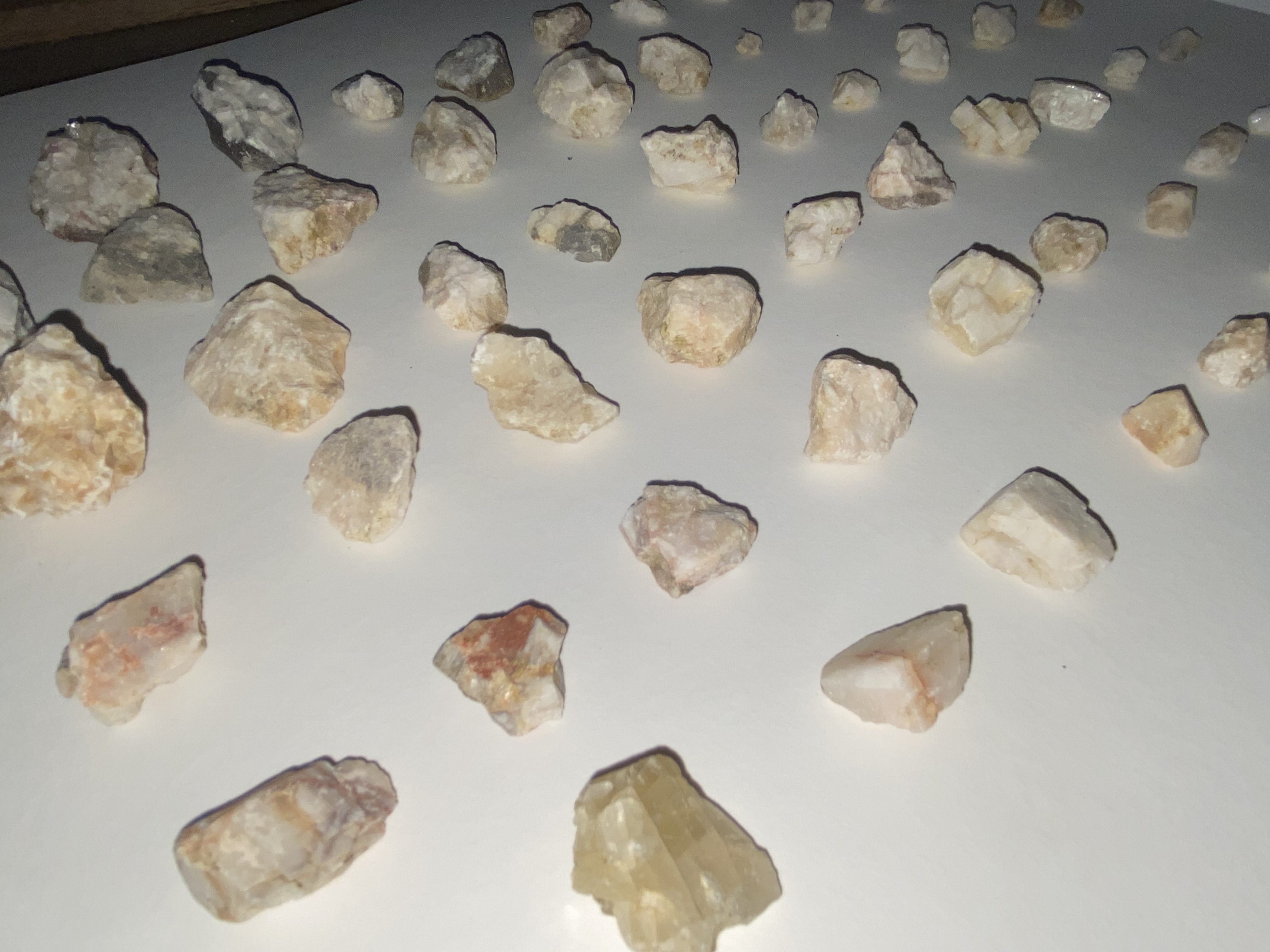
begun collecting limestones from near b y quarries… found the calcite crystals amongst the debris of the quarry walls, was instantly drawn to these whiter crystal-like objects as opposed to what I typically think of as limestone, pale greys and cream rocks.


the interest for me was more in the fact a substance of remediation for one extraction sites ‘waste’ lay in the waste of another extraction sites… in a mere 3 mile radius

upper circle is the site of acidic spoil, the lower circle is the site of remediatory stone.
I created the topographic, 3D map using QGIS




 THINKING RESEARCH